Math Mazes
one path, four levels
A math maze is practice that feels like a puzzle: students solve each fact, color every square that matches, and follow the colored squares from Start to Finish. I built six packs on that one routine, so the format stays familiar while the math changes. Every pack has 40 mazes in four levels of support, a teacher overview, and complete answer keys.
Choose your pack
Shapes for the youngest students, addition and subtraction within 20 for grades 1 and 2, and multiplication, division, and rounding for grades 3 to 5. Each row opens the resource on Teachers Pay Teachers, where you can see the full details and preview pages before you buy.
- Grades K to 2Find the shape, then sides and corners2D Shapes Mazes
- Grades 1 to 2Facts within 10, then teen sumsAddition Within 20 Mazes
- Grades 1 to 2Within 10, then minuends 11 to 20Subtraction Within 20 Mazes
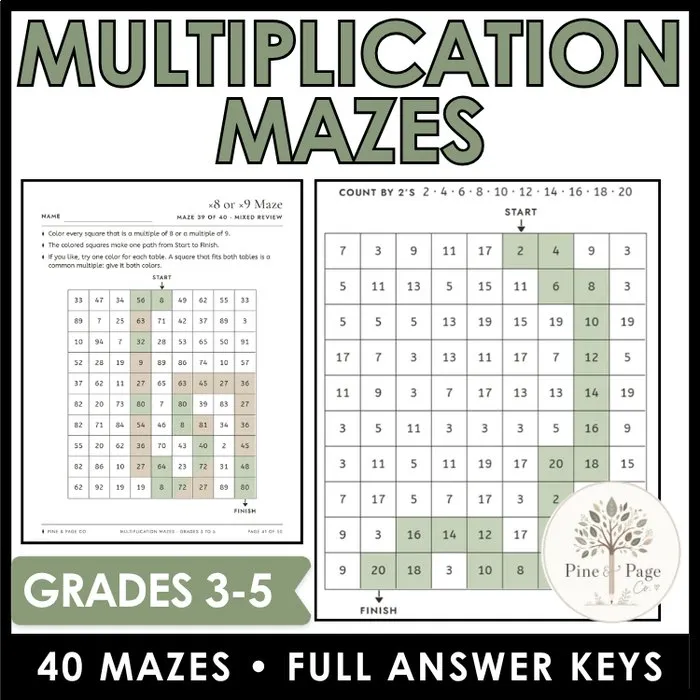
- Grades 3 to 5Times tables 1 to 10Multiplication Mazes
- Grades 3 to 5Divisors 1 to 10, with remainder checksDivision Mazes
- Grades 3 to 5Whole numbers, nearest ten and hundredRounding to 10 and 100 Mazes
How a math maze works
Every square in the grid holds a fact, a number, or a shape. Students work each one and color the squares that match the target: a sum, a difference, a multiple, a rounded number, or a shape. Matching squares share a side and form one continuous path from Start to Finish, so a wrong answer shows up as a dead end and students check themselves as they go.
The four levels change the support, not the routine. The first two levels list the facts, multiples, or picture models on the page. The challenge level removes the list and adds carefully placed near-miss decoys. The mixed review level combines two targets in one grid, with an optional second color.
Nothing is cut or assembled. Students need a pencil or crayon, every page prints in black and white, and each pack ends with the answer key, every path shaded. For how to introduce the routine and choose a level, read the math maze routine post on the blog.
Where they fit
Math centers once the routine has been introduced, morning work, early finisher folders, homework, sub plans, small-group intervention, and quick formative checks. For kindergarten and first grade, start with the picture-supported pages and model one maze together first. The packs pair with the teach-first booklets on the math facts page: the booklet teaches the fact family, the mazes practice it.
Questions teachers ask
What is a math maze?
A grid of squares with a Start and a Finish. Students solve each fact, or check each shape, and color every square that matches the target. The correct squares share sides and form one continuous path through the grid, so a wrong answer shows up as a dead end. No diagonal moves.
Which grades do the maze packs cover?
Six packs from kindergarten to fifth grade: 2D shapes for grades K to 2, addition and subtraction within 20 for grades 1 and 2, and multiplication, division, and rounding to the nearest 10 and 100 for grades 3 to 5. Each pack has 40 student maze pages in four levels, so you assign by readiness rather than by grade alone.
What do students need to complete a maze?
A pencil or crayon. A second color is optional on the mixed review pages. Nothing is cut, sorted, or assembled, every page prints in black and white, and each pack includes a teacher overview and an answer key with every path shaded.
How do the mazes fit with the math facts booklets?
The booklets teach a fact family first; the mazes give that same family a quieter kind of practice with four amounts of support. Many teachers introduce a table or a fact set with the booklet, then move the maze pack into centers, morning work, or early finisher folders.
The booklets and practice packs live on the math facts page, more quiet challenges are in the early finishers collection, the free products are on the free resources page, and everything else is on the main shop page.