Math Mazes: The Routine for Centers and Early Finishers
Math mazes for centers and early finishers: how to introduce the routine, choose the right level, and pick the printable pack that fits your class, K to 5.
My favorite practice pages don’t look like practice. The word ladders cover the reading side. Math needed its own version, and I looked for a while before I built one myself. Math mazes. (Yes, mazes. Stay with me.)
A math maze is a grid of squares with a Start and a Finish. The directions fit on one line. In the multiplication pack: color every square that’s a multiple of 7. The colored squares make one path from Start to Finish. A wrong answer breaks the path or branches off it, and students usually spot that themselves.
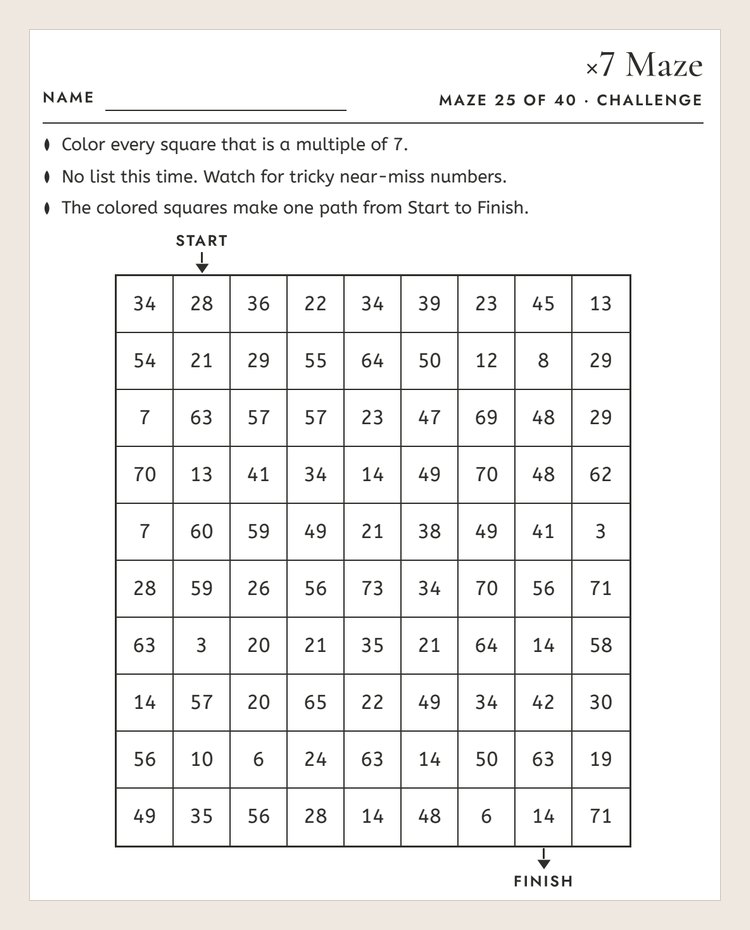
Maze 25 of 40 from the multiplication mazes, the challenge level: no list, near misses included.
How I introduce a math maze
Pick a fact set the class already knows. Model one maze together first: read the rule out loud, color the first two matching squares from Start, and show that the path never moves on a diagonal. Then hand out the page. When one comes back with a dead end, we find that square together.
After that, the mazes live in the math center, the early finisher folder, and the sub tub.
Choosing the level
Every pack has 40 mazes in four levels, and the routine never changes. Take the sevens. The first two levels list the multiples of 7 across the top, so the help is right there on the page.
The challenge level drops the list and lets near misses in (57 and 48 look like they belong, and they don’t). The last level mixes two tables in one grid, with a second color for the squares that fit both.
Start where the help is. Move up when a maze comes back clean and the student can tell you why 48 didn’t belong. Two students can work the same table at different levels, and the routine doesn’t change.
Which pack fits your class
There are six printable packs now. 2D shapes for grades K to 2, where students color every circle, then every shape with three sides. Addition and subtraction within 20 for grades 1 and 2. Multiplication, division, and rounding to the nearest 10 and 100 for grades 3 to 5. Same routine, different math.
Nothing gets cut or sorted. Students need a pencil or a crayon, and every page photocopies in black and white. The answer key shows each path shaded, so checking a page takes a glance.
If your class hasn’t met the facts yet, start with the free multiplication facts booklet or the other math facts booklets. The booklet teaches the table. The mazes take it from there.
So tell me: which table is the stubborn one in your room this year? Sevens, in mine. It’s always the sevens.
Warmly,
Kristen
Keep reading
Free Fall Word Ladders, Grades 1 to 5
Try five free fall word ladders right here, one for each of grades 1 to 5. Every grade's full set has 50 Halloween and fall ladders.
The Word Ladder Routine
Word ladders in the elementary classroom: a five-minute routine for phonics, spelling, and vocabulary, plus printable no prep worksheets for grades 1 to 5.

The First Five Days
What I prioritize for success in the first week of school: connection before content, quiet icebreakers, and five days of going slow on purpose.