Teaching the Times Tables 1 to 10, One Table at a Time
Teaching the times tables in grades 3 to 5, one table at a time: a lesson page, then a practice page. Print the free multiplication booklet for tables 1 to 10.
Free printable
Free times tables booklet
Here's my free multiplication facts booklet: a lesson page and a practice page for every times table from 1 to 10, then a times table chart, a bonus maze, and an answer key. No sign-up, no account.
Prefer to keep it in your TpT library? Get it free on Teachers Pay Teachers.
Terms of use: Free to print and use with your own students. Please share a link to this page rather than the PDF files. Not for resale.
I’ll be honest: a full multiplication chart scares some kids. A hundred boxes of numbers looks like a lot. (It is a lot.) So I don’t start with the chart. I start with one table.
That’s how my free booklet works. It runs from the 1s to the 10s, and every table gets two pages: a lesson, then practice. The whole chart waits until after the 10s.
Teaching the 3 times table
Take the threes. The lesson page opens with one worked example: 3 × 4 → 3 + 3 + 3 + 3 → 12. Right under it, the page says “think: add 3 four times.” Then the trick: count by 3s. Three, six, nine, twelve.
Beside the example, four rows of three dots show 4 groups of 3. Three short steps walk through it again. The bottom of the page lists the whole table, from 3 × 1 to 3 × 10.
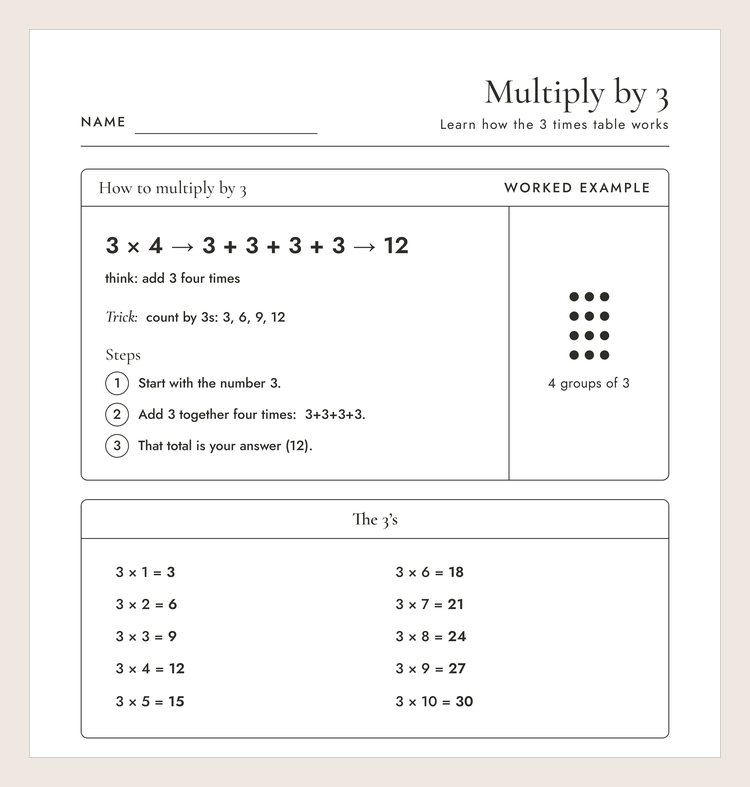
The 3s lesson page from the free multiplication facts booklet.
Every table from 1 to 10 uses the same layout. By the third or fourth table, students know exactly where to look.
Then the practice page
The practice page comes right after the lesson. First the 3s in order, then the same facts mixed up. The last box is a challenge: 3 times what makes 24?
The directions send students back to the strategy box on the lesson page, so I keep both pages out together. There’s a scratch pad too, for anyone who wants to draw the groups.
The chart comes last
After the 10s, students get the whole times table at once. The page shows how to read it: one finger down the side, one along the top, then slide them together. Where they meet is the answer.
Next comes a blank chart to fill in. The tip at the bottom says to start with the tables you know best, then use them to help with the rest.
There’s a bonus page too, a maze from my Multiplication Mazes. Students count by 3s and color each number in order. The colored squares make one path from Start to Finish.
After the times tables
Page 2 of the booklet is just for teachers. It maps out where to go once the tables are taught.
The Practice Pack picks up where the booklet ends, with multiplication flowers, a riddle, and two fact checks. The mazes turn the same facts into 40 puzzles in four levels. Division works the exact same way: a booklet first, then a practice pack.
So tell me: do you teach the tables in order, or start with the 2s, 5s, and 10s? I’m always curious how other rooms do it.
Warmly,
Kristen
Keep reading
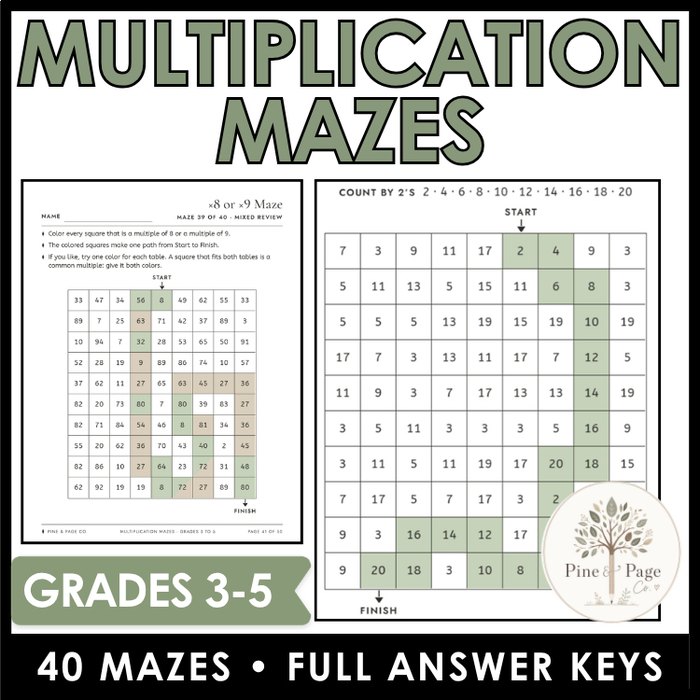
Math Mazes: The Routine for Centers and Early Finishers
Math mazes for centers and early finishers: how to introduce the routine, choose the right level, and pick the printable pack that fits your class, K to 5.
Free Fall Word Ladders, Grades 1 to 5
Try five free fall word ladders right here, one for each of grades 1 to 5. Every grade's full set has 50 Halloween and fall ladders.
The Word Ladder Routine
Word ladders in the elementary classroom: a five-minute routine for phonics, spelling, and vocabulary, plus printable no prep worksheets for grades 1 to 5.