The First Five Days
What I prioritize for success in the first week of school: connection before content, quiet icebreakers, and five days of going slow on purpose.
Every August, somewhere between the supply aisle and the first staff meeting, the same quiet (or very loud) pressure shows up: hit the ground running. Get into the books fast. Prove the year’s worth by Friday.
I’ll be honest about what actually happens in my room: the books stay closed longer than you might expect. Not because the learning doesn’t matter to me, but because of something I believe more and more every year. Students can’t learn in a room they don’t yet know how to navigate.
And here’s the part nobody prints on the school calendar: in that first week, every brain in the room is still in summer mode. Mine included. Coming back is a transition for all of us, and transitions go best when they’re slow on purpose.
So for the first five days, we learn the room. Connection before content, structure before strain. Here’s what that actually looks like.
(Everything you’re about to read comes from our First Week of School Calm Kit, if you’d rather have the whole week already planned.)
Day one is for shrinking the unknown. Back-to-school nerves, for students and for teachers, mostly come from the same place: not knowing what to expect. So we start right there. How we come into the room. Where backpacks live, where finished work goes, how we gather at the meeting area and what we do when we get there. On paper it looks like almost nothing. In the life of a classroom it’s everything, because a student who has an idea of what’s going on, what things are going to look like, and who their teacher is, is a student who can exhale.
Day one is also for getting to know me. What kind of teacher I am, what kind of teacher I strive to be, and everything I hope we can accomplish together this year as long as we keep our classroom calm, cool, and collected. Students settle faster for a teacher who’s a person instead of a mystery.
The middle of the week belongs to routines. One or two a day, taught like real lessons: what it looks like, what it sounds like, then practice until it’s boring. How to ask for help. What independent work sounds like when the room goes quiet. Lining up without the hallway drama. Bathroom and water without an announcement. Where supplies live and how they come back. Boring is the goal here. Boring means everyone knows, and everyone knowing is what calm is made of.
Every day, a sixty-second check-in. Fist to five on day one, whisper a word on day two, quiet thumbs midweek. It isn’t a program and it isn’t therapy. It’s one small question, how are you arriving, asked before the day starts moving. A student who comes in at a two needs me to know that before the math does.
The icebreakers are the quiet kind. I have never loved icebreakers that spotlight exactly the students who dread a spotlight. So we do find-someone-who, silent this-or-that with the room split in two, calm would-you-rather, a partner interview where drawing your partner counts as answering. Nobody performs. Everybody belongs. That’s the whole point of week one.
By Friday, we write our class promise together. Not my rules laminated over their heads. Their words, written with them, about the kind of room we want to live in. Students keep promises they helped write in a way they will never keep a poster.
And families are part of the week too. True partnership with families, working together for the same student, matters as much as anything else on this list, and it starts with positivity and open communication in week one. A short getting-to-know-your-child form goes home so families can tell me anything that will help me make the classroom a better fit for their child. Then on Friday, a little note of positivity about how the week went, a simple checklist I made ahead of time with a memo space at the bottom, so the first thing families hear from me is a good thing.
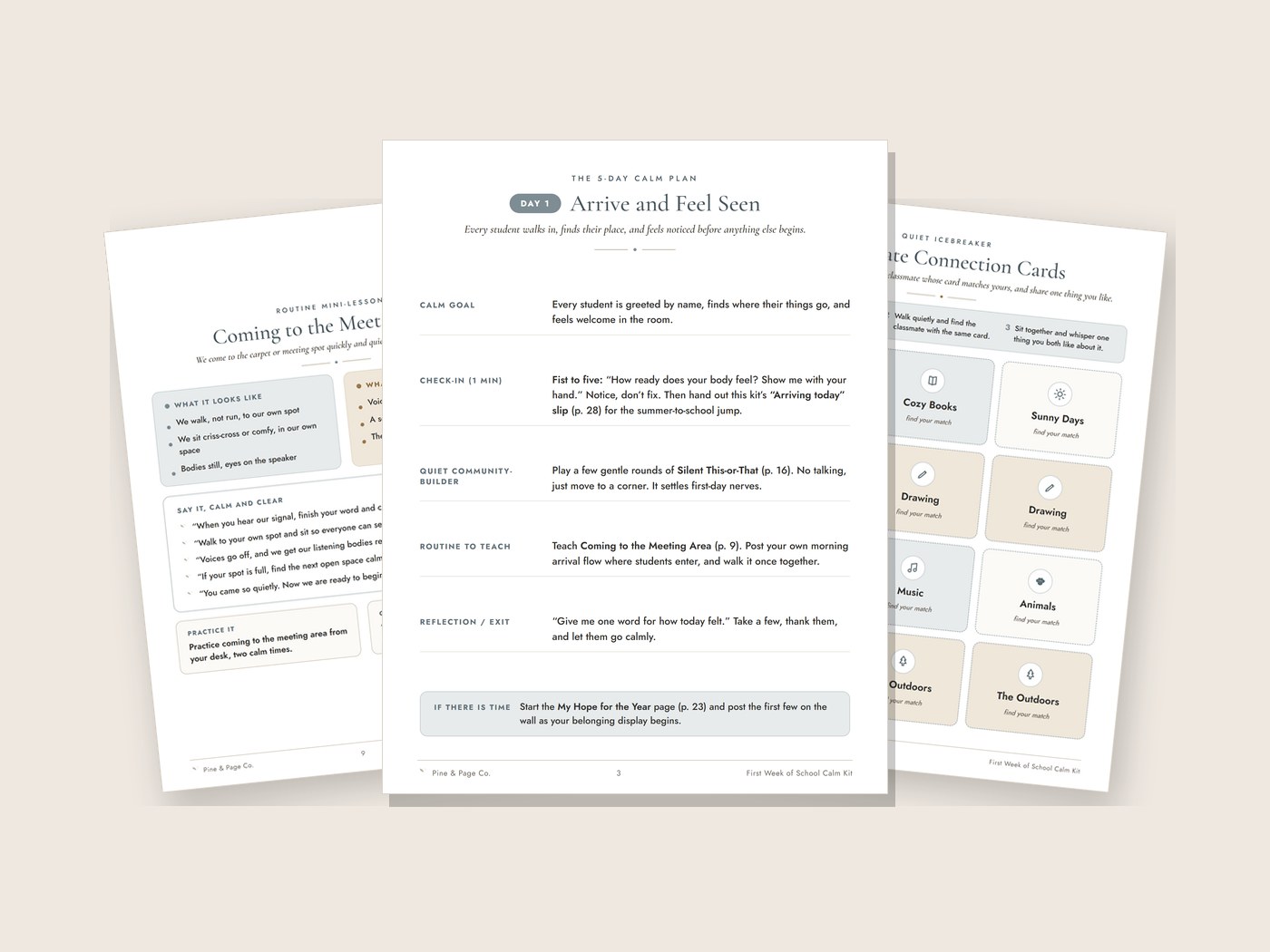
After enough summers of rebuilding this week from scratch, I finally put all of it into one place: the five-day plan, the routine lessons, the quiet icebreakers, the class promise, the check-ins, the family pages. It’s the First Week of School Calm Kit in our shop, and it’s the exact week I run. It sits alongside the rest of my calm classroom collection too.
If you’re a new teacher staring at a blank plan book in July, here is the thing I wish someone had told me sooner. The first week doesn’t have to be impressive. It has to be steady.
Teach them the room first. The rest gets easier.
Warmly,
Kristen